Key details
Date
- 22 May 2026
Author
- RCA
Read time
- 1 minute
ECH and the RCA have launched a new project to commission a major public artwork celebrating the overlooked communities of the London Borough of Newham.

Key details
Date
- 22 May 2026
Author
- RCA
Read time
- 1 minute
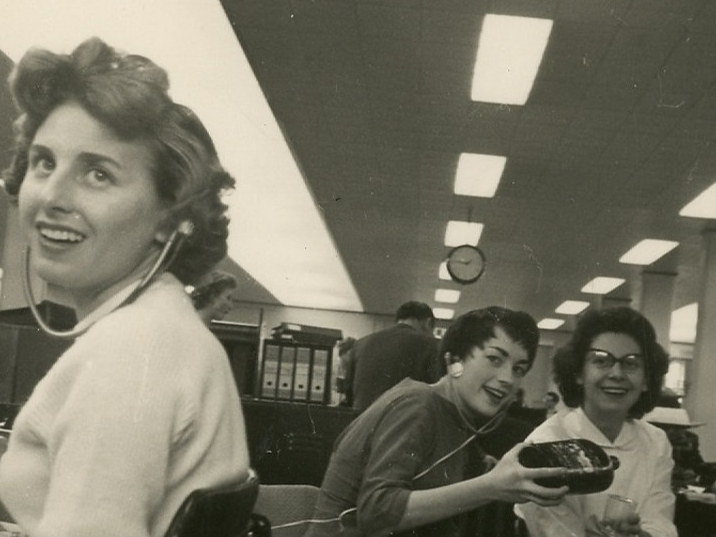
(Bonny and two colleagues sat at their desks with their headphones in from her time working as a typist at Ilford Limited, circa 1960s, from the Snapshots Through Time Project, Credit: Eastside Community Heritage)
Eastside Community Heritage (ECH), in partnership with the Royal College of Art (RCA), has launched a new project to commission a major public artwork celebrating the overlooked communities of the London Borough of Newham.
The project, supported by Arts Council England’s National Lottery Project Grants, will invite visual artists to respond creatively to ECH’s renowned Hidden Histories archive, a collection of over 4,000 oral histories and approximately 40,000 photographs documenting the lives of working-class, immigrant, and disabled communities across East London.
Through an open call, three artists will be selected, and each awarded a development budget to create a proposal responding to one of three themes drawn from the archive: Working-Class Voices; South Asian/Black Communities; and LGBT+ Experiences. Each artist will produce an Artist’s Book presenting their vision, which will be exhibited online and across Newham’s libraries in Stratford, Plaistow, and Green Street, giving the wider public the opportunity to respond before a winning commission is selected.
The project is guided by a Creative and Community Panel chaired by the RCA’s Professor Rachel Garfield, and includes the RCA’s Professor Harold Offeh, Head of Programme, Contemporary Art Practice MA, and Dr Joanne Tatham, Tutor (Research), MFA Arts & Humanities, alongside UCL Citizen Social Scientist Twinkle Jayakumar and representatives from Newham’s Asian, Chinese, and LGBT+ communities. Crucially, community panel members will hold equal standing with academic and artistic colleagues throughout the selection process, a deliberate reversal of traditional power dynamics in public art commissioning.