Key details
Date
- 6 January 2025
Read time
- 11 minutes
Four graduates of the RCA’s Service Design MA share the impact the programme has had on their careers.
Key details
Date
- 6 January 2025
Read time
- 11 minutes
Graduates from the RCA’s Service Design MA programme apply their skills to diverse industries. From working freelance for businesses, charities, and NGOs, to working for universities, banks and art galleries. Read on to discover the impact the Service Design MA programme has had on four recent graduates.
Jiaqi Wang (Service Design MA, 2022)

“My graduation project completely changed how I think about design research and what it means to truly understand users.”
Service Design MA + Service Designer at the Royal Borough of Greenwich
What was your journey into the MA programme at the RCA? What did you study before coming to the RCA, and what drew you to the Service Design programme?
I didn't start in design—I began my journey in finance, working with data models and analysis. The turning point came while working at an NGO, where we built a program for young leaders worldwide. Despite achieving 15% revenue growth, we received significant negative feedback from participants.
This experience taught me that brilliant business strategies mean nothing without empathy and understanding of the whole system. You might make money, but you won't make meaningful impact. When a friend introduced me to service design, it clicked immediately—it was the perfect bridge between my business background and my passion for human-centred social innovation.
Service design offered exactly what I was looking for: a way to combine strategic thinking with genuine care for people's experiences.
Where are you now, and how did studying Service Design MA at the RCA help you get here?
Right now, I'm working as a service designer at the Royal Borough of Greenwich, and I've also co-founded something called Hybrid Lab; a research association exploring speculative design.
Looking back, the RCA really transformed how I approach design in three ways that I still carry with me every day:
The foundation it gave me was incredible—I remember those early sessions where we'd dive deep into different design methods. But what really stuck wasn't just learning the tools; it was understanding the nuance of each approach and tool and how to tweak them when a project throws you a curveball.
The real-world projects were honestly a bit terrifying at first, but so valuable. I'll never forget the pressure of presenting to actual clients who had genuine problems to solve and budgets on the line. Last is the remote team working: our first year being completely online, which actually became an unexpected gift. At the time, we all felt like we were missing out, but those late-night Zoom sessions and learning to collaborate through screens. That's exactly how most of my work happens now. I honestly think I'm better at remote teamwork because of that experience.
The programme also pushed me beyond my comfort zone. Each project shaped me differently, but the biggest lesson was learning to be bold and experiment without fear of failure.
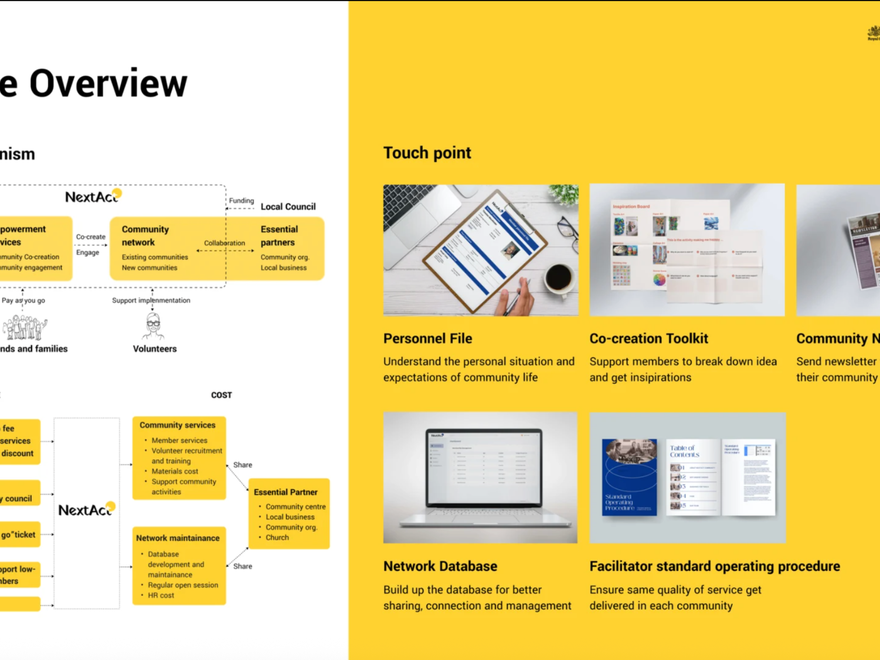
Jiaqi Wang's graduation project was called NextAct, made as part of a collaboration between UKRI, Helen Hamlyn Centre for Design, and Cartwright Pickard Architects
Are there any particular experiences, skills, approaches, methods, or advice from your time studying Service Design that you use in your job day to day
The jump from student projects to workplace reality was honestly quite a shock, but the RCA had prepared me in ways I didn't realise.
The biggest shift was moving from designing for users to navigating messy, interconnected systems. I now navigate complex systems involving residents, council officers, policy teams, senior leaders, external partners, and IT systems—each with different constraints and sometimes conflicting goals. The storytelling methods we experimented with at RCA have become absolutely crucial. Instead of drowning stakeholders in data and process maps, I'll craft narratives around resident journeys or paint scenarios of what success looks like. The constant perspective-shifting is probably what I use most: one day I'm crafting high-level policies, the next I'm designing form details. That ability to zoom in and out came directly from those varied RCA projects. Every group critique and stakeholder presentation built these muscles I use every day now.
Was there a particular brief or project that you worked on that had a big impact on you or transformed your way of thinking about Service Design?
My graduation project completely changed how I think about design research and what it means to truly understand users.
I worked solo on a project called NextAct, part of a collaboration between UKRI, Helen Hamlyn Centre for Design, and Cartwright Pickard Architects. We were exploring innovative architecture for later life from both architectural and service design perspectives. NextAct became this participant-led network empowering people 65+ to engage in interest-based communities on their own terms, fostering continuous connection and healthy aging.
The project made me confront my own biases. I kept reflecting: Am I being ageist? Am I treating them equally? Your perception of users directly influences your project outcome—that was a hard but crucial lesson.
What made this project transformative was experimenting with real-world approaches like MVP testing, theory of change, and business models. The project actually continued after graduation, which shifted my perspective from pure designer to project delivery manager, considering real budgets and limitations..
Did you build good relationships with peers, within the programme or across the RCA? How have these working relationships continued to benefit you throughout your career?
The relationships I built at the RCA became one of the programme's most valuable gifts. My classmates became lifelong connections who continue to support my life and career.
We regularly share job opportunities, discuss common workplace challenges, and provide ongoing support for each other's careers. At the end of the day, design is always about people, and the people you meet at the RCA will enrich your career in unexpected ways.
Agata Juszkiewicz (Service Design MA, 2020)
“Once you are out in the world, you quickly realise: you are part of the RCA family – and that can open doors when you least expect it.”
Service Design MA + product designer at QuantumBlack, AI by McKinsey
What was your journey into the MA programme at the RCA? Where are you now, and how did studying Service Design MA at the RCA help you get here?
I came into the Service Design MA at the RCA with a background in Visual Communication Design, followed by experience in UX/UI design.
Currently, I am working as a product designer at QuantumBlack, AI by McKinsey, where I help to shape the next generation of AI operations tools.
Studying Service Design at the RCA was instrumental in getting me here. It pushed me to think beyond interfaces and consider the broader service ecosystems, systems thinking, and human needs that shape truly meaningful products. Working on real briefs with real clients was a fantastic way to bring theory into practice and deepen my strategic design skills.
Are there any particular experiences, skills, approaches, methods or advice from your time studying Service Design that you use in your job day to day?
- Stay curious and don’t be afraid to ask questions. Curiosity is your greatest tool – it helps you adapt, learn, and thrive, especially in a world being rapidly transformed by AI.
- When presenting, storytelling is crucial. Remember it is your role, as a designer, to help stakeholders empathise and connect with the people you design for.
- Co-creation is key. Take your team and clients on a design journey with you. Collaboration leads to more aligned, innovative, and sustainable outcomes.
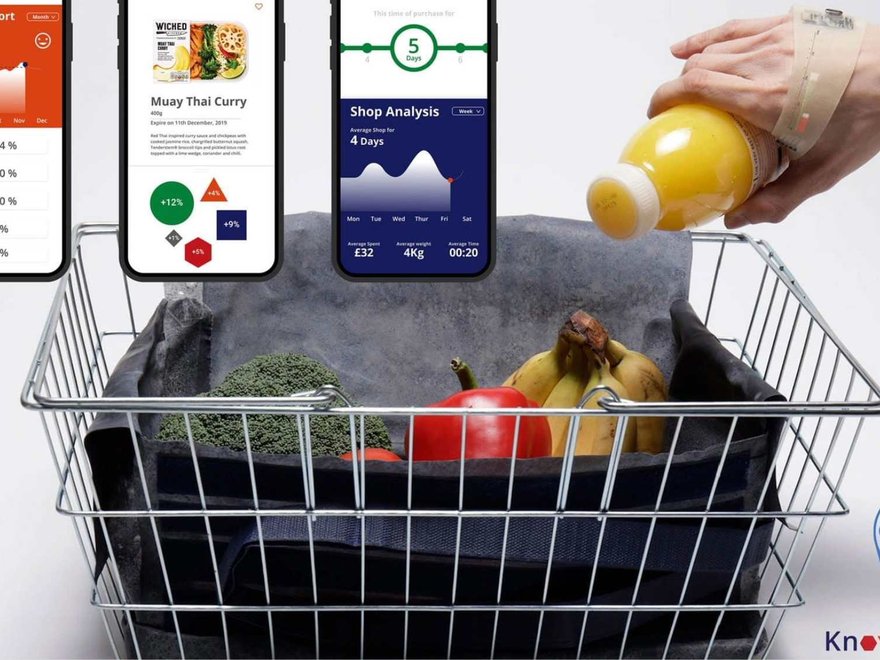
Agata's project, Knowtrition, was created as part of the Grand Challenge in collaboration with students across the School of Design
Was there a particular brief or project that you worked on that had a big impact on you or transformed your way of thinking about Service Design?
One of the most transformative experiences during my time at the RCA was working on the Grand Challenge in partnership with CERN (the European laboratory for particle physics). Collaborating with students across the School of Design, we explored how disruptive technologies can tackle global challenges, through design. Our project, Knowtrition, got recognised and we were invited to present it at CERN. Working in a cross-disciplinary team and being mentored by CERN scientists was an unforgettable experience – it showed me how far human-centred design can take you when combined with bold, visionary thinking.
Did you build good relationships with peers, within the programme or across the RCA? How have these working relationships continued to benefit you throughout your career?
It was truly a privilege to be surrounded by a group of such talented designers – to collaborate, have fun and learn from each other! Those memories will stay in your heart forever. Once you are out in the world, you quickly realise: you are part of the RCA family – and that can open doors when you least expect it.
Ziwei Liu (Service Design MA, 2021)

“On the Service Design MA, project-based learning and client interactions exposed me to real-world conflicts and ambiguous demands, which strengthened my ability to adapt quickly and stay calm under pressure.”
Service Design MA alumni
Since graduating Ziwei Liu has worked as a service designer for Think Academy International Education Limited and is currently user experience and service specialist for the University of Reading. Before coming to the RCA Ziwei Liu studied Industrial Design.
How did studying Service Design MA at the RCA help you get where you are now?
The Service Design MA at the RCA had a huge impact on my skills. I would definitely recommend this programme to anyone with a love for systems thinking and a genuine drive to make a practical positive impact on society.
The RCA trained me to identify the issues quickly and accurately, especially when stakeholders’ initial perspectives are diverse. On the Service Design MA, project-based learning and client interactions exposed me to real-world conflicts and ambiguous demands, which strengthened my ability to adapt quickly and stay calm under pressure.
Are there any particular skills from your time studying Service Design that you use in your job day to day?
In my daily work, mapping is one of the most requested and essential tools. It helps teams see the big picture and dive into specific insights extremely quickly. For soft skills, I would say collaboration and respect are crucial. It might sound simple (and a bit silly), but truly respecting non-expert stakeholders and users is not always instinctive for me. I constantly remind myself to avoid assuming anything is “common sense” in conversations, as it may not be familiar to everyone else.
Did you build good relationships with your peers at the RCA?
As an international student working in the UK, I see my RCA classmates as my family here. They’re not just a professional network but a source of personal support, which has been invaluable as I navigate my career and life abroad.
Angus Bamford (Service Design MA, 2023)

“Studying Service Design MA at the RCA provided me with the knowledge and tools to be a changemaker and innovator.”
Service Design MA alumni
Angus is digital product manager at Tate. He came to the RCA from a background in arts management and dance.
Where are you now, and how did studying Service Design MA at the RCA help you get here?
I'm currently a product manager, focused on improving the visitor experience at Tate Galleries. My service design skills help me align the organisation’s operational models with the expectations of visitors across Tate’s four galleries in the UK.
Studying Service Design MA at the RCA provided me with the knowledge and tools to be a changemaker and innovator. More than that, it gave me the confidence to believe in my ideas and engage with a wide range of people – from the public and users to senior directors and investors.
Was there a particular project that had a big impact on you?
I worked on a project with Catch22 and the Ministry of Justice to support individuals leaving probation by providing mentoring support. We spent a lot of time with the service providers, aiming not to revolutionise their process, but to find small, meaningful ways to support them.
This project taught me that empathising with both users and providers is essential. Working closely with providers also reminded me of the importance of “asking the stupid questions” and pointing out obvious solutions – sometimes, these make the biggest impact. Now, I make a point to immerse myself in both the user’s and provider’s perspectives to avoid bias and assumptions in my work.
Did you build good relationships with peers within the programme or across the RCA?
I learned so much from working closely with other talented designers. Coming from a background in social sciences and arts, I was new to "Design" with a capital "D." By working side by side with designers – watching how they work, asking questions – I got hands-on experience with the tools, methods, and applications of design. The relationships we built in the programme have continued well beyond the course and turned into some long-lasting friendships.
Kristof van der Fluit (Service Design MA, 2021)

“The Service Design MA programme has instilled in me an inherent design-response throughout my early career, not only to ask questions and carefully listen, but to feel agency in the creative act of building, discovering, negotiating and shaping.”
Service Design MA alumni
Kristof studied design engineering before joining the RCA. He is now a service designer for Close Brothers.
Where are you now, and how did studying Service Design MA at the RCA help you get here?
As a service designer, I have had the fortune of working across sectors; at Deloitte Digital on projects such as One Login for the UK’s Cabinet Office, and now in financial services for a bank listed in the FTSE250. In both contexts, I faced the challenge of designing for a wide population. Taking my learnings from the RCA, I continually step back and think about how technology relates to individual experiences within services.
Are there any particular experiences, skills or approaches from your time studying Service Design that you use in your job?
The Service Design MA programme has instilled in me an inherent design-response throughout my early career, not only to ask questions and carefully listen, but to feel agency in the creative act of building, discovering, negotiating and shaping.
During my time on the programme, I felt an overwhelming sense of social responsibility, optimism and inspiration from our Head of Programme, my tutors and fellow designers. The atmosphere on the programme was empowering. We believed we had the responsibility on the programme to define the future direction of service design, to ask ourselves: what’s next?
Was there a particular brief or project that you worked on that had a big impact on you?
Working with a team of friends on a brief set by course tutors and the policy team at London Borough of Camden, had a positive impact on my confidence as a designer. With the motivational support from our tutors, we tested a real-life prototype of the service, at the outbreak of COVID-19. Our ‘Minimum Viable Service’, helped match residents in need to community run initiatives in their neighbourhood and was being promoted by local charities including Camden Giving. Having this experience is invaluable. Every time I am in need of extra motivation I think back to this moment.
Charlie Fountaine (Service Design MA, 2020)

“Studying on the RCA Service Design MA helped me gain confidence in design, and fill my portfolio with the kinds of projects that I am interested in.”
Service Design MA alumni
Charlie is a freelance Service and Interaction Designer. Before coming to the RCA she studied communication design at Glasgow School of Art, then worked at Snook, a service design agency in Glasgow.
Where are you now, and how did studying Service Design MA at the RCA help you get here?
I’m a freelance service and interaction designer. Studying on the RCA Service Design MA helped me gain confidence in design, and fill my portfolio with the kinds of projects that I am interested in.
One of my tutors connected me with Mind, the mental health charity. There I was able to do an internship, which led to doing a student project with them. This expanded my knowledge of designing mental health services, which I loved.
Are there any particular experiences, skills, or advice from your time studying Service Design that you use in your job day to day?
One of the skills that we were encouraged to develop during the course was public speaking. At the RCA I learned to present my ideas in a clear and persuasive way – I use this a lot now I’m a freelancer.
Was there a particular brief or project that you worked on that had a big impact on you?
I loved working with Doctors Without Borders on their hospital handover process. I reached out to the innovation director at the charity and he gave me a lot of support. As a result I got good buy-in from the organisation to improve the handover between international staff who go over to deliver medical care in war zones and countries affected by natural disasters.