
Enhancing Human-Product Attachment (HPA) through the Sensory Experience of Circular Embroidery Design Practice
Our current economy operates as a linear system, where fashion businesses and consumers exist in a system of constant production, consumption and disposal. Textile and fashion industries leverage aggressive marketing, facilitating over-consumption without consumer awareness of design and production processes, leading to waste. Current consumption habits have diminished consumers' multi-sensory experiences of physical items contributing to consumer disconnection to products. Furthermore, fashion/ textile products lack layers of complexity and sophistication in meaning causing consumers to lose interest in them. These failed consumer-product relationships show that designers are failing to design products that aid consumers in developing emotional bonding towards their textile possessions.
As part of our mission to transition to a Circular Economy (CE), my research aims to understand how sensory experiences of materials can foster human-product attachment (HPA) within a circular fashion /textile industry. Micro-phenomenology Interview and Analysis method combined with Material Driven Design form the backdrop of my research methods - I am using embroidery as a sensory tool to aid HPA whilst acknowledging its design challenges related to circularity. Within this context, my research reflects on and identifies the issues, factors, constructs and determinants affecting human-product attachment. Understanding these factors, constructs and determinants provides insight into producers, consumers and product relationships. The literature suggests that to facilitate long term HPA, designers should develop products that explore multi-sensory experiences and affective responses that evoke emotional bonding to textile products.
Current research into sensory experience of textiles goes beyond the technical and tactile perception of textiles and seeks to understand at a deeper level the affective responses that lead to emotion based experiences. This led me to reflect on my key research question – Does the sensory experience of materials (embroidery materials, products or processes) and their affective responses elicit and enhance long term HPA? In highlighting this main problem, I also identify a sub-question related to embroidery circularity. An important tenet of CE is to ensure products remain in use for as long as possible and have a regenerative life-cycle. CE design requires adopting eco-design strategies that encourage product longevity and recyclability within a circular system. In highlighting this problem, I ask – how can we design embroidery for CE ? The coupling of these two questions presents a possible design solution for HPA within a circular fashion and textile industry.
Key details
Area of expertise
Supervisors
Gallery
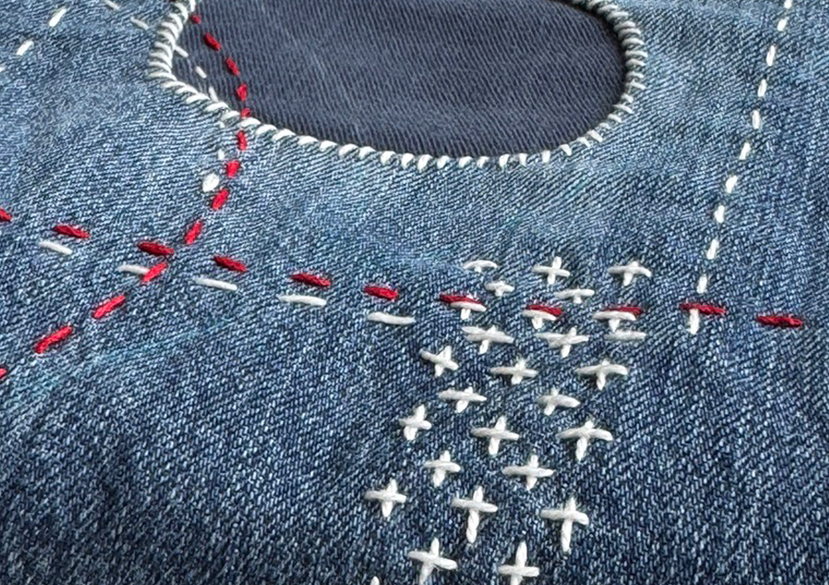
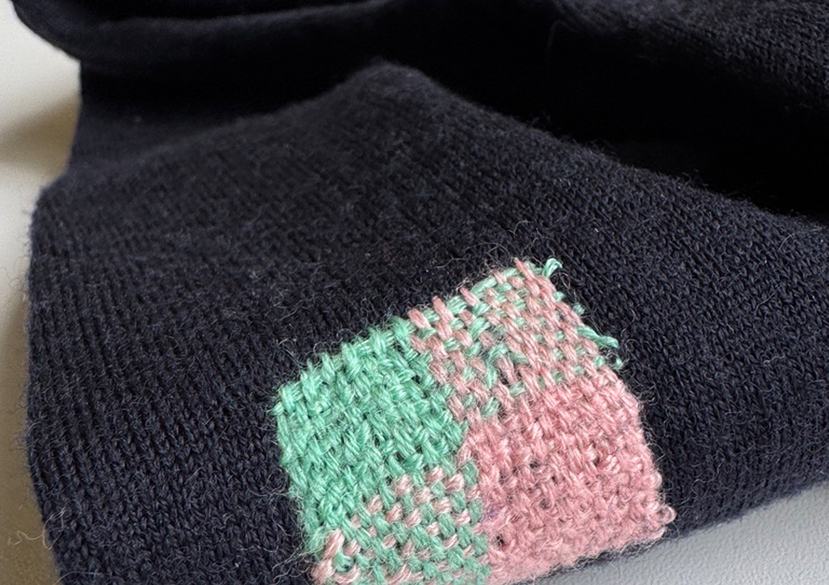
More about Emma
Biography
Emma Harris is a design researcher and practitioner with a background in fashion design, pattern-cutting and textile design - focusing on embroidery practice. Emma is interested in bridging the gap between designers' and consumers' knowledge and experience of regenerative biomaterials and circular design processes. She is interested in inter-disciplinary and trans-disciplinary approaches to design, psychology and scientific research.
Degrees
MA Contemporary Art Theory, Goldsmiths University, London, 2019 - 2020
MA Fashion and the Environment. London College of Fashion, University of the Arts, London. 2013 - 2011
BA Fashion Design Technology. London College of Fashion, University of the Arts, London. 2005 - 2008
Experience
Designer, Studio Erskine, 2014 – 2017
Associate Lecturer: Design and Pattern Cutting, London College of Fashion, 2010 – 2013
Creative and Production Pattern Cutter, Brora, 2010 - 2012
Assistant Designer and Pattern Cutter, E.Tautz, May - Sept 2010
Assistant Designer and Pattern Cutter, Preen, 2008 - 2010
Designer/Pattern Cutter, Global Mamas, Aug - Sept 2008
Awards
2022: RCA PhD Studentship scholarship
2011: Erasmus: Design Camp, Designskolen, Kolding
2008: Scholarship - Global Mamas Volunteer
2008: Womenswear: Marchepole Annual Bursary
Funding
Emma's research is funded through a full RCA Studentship Scholarship.